
sexta-feira, 16 de novembro de 2012
"A moral da percepção"


quinta-feira, 15 de novembro de 2012
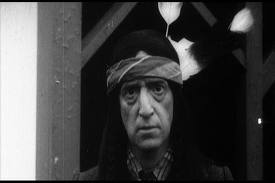
Zelig, de Woody Allen, sob o olhar de Serge Daney
Aqui vos deixo uma versão inglesa do texto de Daney, sem conseguir deixar de me lembrar de umas colegas que, na altura, adormeceram a ver o filme.
Que Deus, na sua infinita misericórdia, lhes perdoe.
Ei-lo:
Saint Zelig, pray for us
 Where it’s clear that only a filmmaker can give some meaning to what television does without thinking and that we owe Woody Allen the hypothesis of the embodied zapping.
First came euphoria, a dream of ubiquity finally within reach of the hand (then of the thumb, a part of the hand). Thanks to television, being everywhere would cease to be the privilege of the sorcerer’s apprentices akin to Orwell or Mabuse. Once surveillance was democratised, the spectator’s eye started to scan, faster and faster, several strata of images. From the raw documentary of the news to the quiet family shows, from the black and white stock shots to the bright colours of the weather maps, from the MGM lion to the successive test patterns of national public television (1). In the meantime, the ear was adjusting to several types of voices: discoursing or teasing, commenting or stuttering, dubbed or original. “The world at home” was what it was all about.
All this existed especially when there was only one television channel. The multiplication of channels has slowly created the reverse feeling of a fundamental “unity” of all images and sounds on television. As if too much diversity was detrimental to the very idea of diversity, and if too much choice rendered trivial the act of choosing. The practice of zapping probably came from this desperate desire to anticipate a nausea certain to arrive. An ambiguous act, zapping carries two contradictory desires. Sometimes we are trying to prove that “elsewhere” (i.e. on another channel) is just the same. Other times we want to enjoy – even for an instant – the appearance of diversity and to dream that it’s more than an appearance. In the first case, we angrily conclude to the prominence of the medium over the message, and in the second case we still seek the moments (a few seconds is all it takes) where our habits are tricked by a show temporarily new. But, like those who want to run faster than their shadows, or who count their chickens before they are hatched, we end up forgetting that an image is made to be seen.
Does the Same, multiplied by the Same, equals the Other (like the multiplication of two negatives makes a positive)? It’s too serious a question to be left to the television people (too busy pretending to be unique and confuse variant and difference). Inversely, it’s a question for the reverie and jurisdiction of filmmakers. Only filmmakers can calmly “analyse” what television is only proposing as a hysterical synthesis. Cinema – and this is not new (Vertov, Rossellini, Welles, Godard, etc.) – is the conscience of television. It’s often its last dignity left. Filmmakers, because they anticipate a process which will eventually escape them, have the time to think about it and make it their own personal concern. But those who inherit from these processes often have the upstarts’ stubborn presumptuousness. Let’s be precise. With Fritz Lang the idea of surveillance is fascinating (The Testament of Dr. Mabuse) and with Rossellini, the idea of fictionalised news is overwhelming (Paisa). With Welles, the idea of de-programming is staggering (Mr. Arkadin) and with Godard (or Bresson) the idea of forced and indifferent choice is close to anguish. Artists will always be truer than media-people.
And it’s with Woody Allen that the idea of zapping eventually becomes emotive. To watch one morning (on Canal +), drowned amongst other images, a movie like Zelig (1983), is to find to this film a depth that it didn’t have in movie theatres, in front of an audience too enlightened, too “second degree”. Television is the true environment of this film. If the bases of Woody Allen’s films are almost always robust or ingenious ideas (a real history of mediation in the 20th century, going through the de-sublimated star system and the moving evocation of radio), they rarely have a strong enough inspiration to make real films. But only a filmmaker could invent Leonard Zelig, this mutant whose body is zapping through history and through the different ways to film history.
Who’s Leonard Zelig? A nice boy who wants to be loved by the others so much that he finds nothing better than to physically look like them. Zelig is like the cursor of the word processing machine this article is written with: where he is, it’s the Same, and everywhere else is elsewhere. He moves from a body to another just as we hop from channel to channel. He becomes tinged with otherness. He has recourse to mimicry, like these animals which fascinated Lacan. His body (a strange body, good for science, a body made of acetate or nitrate) adapts to the environment, eventually dissolving into it. That’s the true novelty. Unlike the great disguised characters of the past (who dressed up, like Tony Curtis in The Great Impostor by Mulligan), Zelig slips naturally in the skin of others. That’s how we discover him, a scandalous object in the immediate entourage of the Pope or Hitler. This is how he realises our dream of ubiquity (the famous “little mouse” since then become heroin of some personal computers).
We know that cinema would not exist without the persistence of vision. With Zelig, there is another persistence: of a role into another, of a channel into another. Zelig symbolises our desire to be everywhere at the same time (incognito) and our refusal to lose the endangered “thread” of our nomadic life. But we or Zelig no longer travel around the wide world but through those countries which are the different genres of known images of the world: through the interview, the current affairs documentary or the Hollywood film. A chemical world is leading to chemical bodies, and chemical bodies lead to new types of metamorphoses.
The culture of narcissism (a theme long addressed by the Americans) leads to paradoxes in which Woody Allen visibly revels. In the past, a mirror was enough (“Je ris de me voir si belle en ce miroir”, etc.). Today, it’s through the superficial diversity of the TV-things on display that we want to catch the trace of our imaginary presence, even in the (rather minimal) form of the gaze. What we see returns our image, the image of those who, as John Berger said, wanted to “see the seeing”. So for once, Zelig devotes himself out to “represent” our gaze in the country of things watched. We then found ourselves on both sides of the screen and concluded to the “crisis” of cinema.
(1) “ORTF” in the French text: Office de Radiodiffusion Télévision Française – the old state-owned public broadcaster which dominated French television up until 1974.
Originally published in Libération on October 6th, 1987. Reprinted in Le salaire du zappeur, Éditions Ramsay, 1988. Translation by Laurent Kretzschmar
Where it’s clear that only a filmmaker can give some meaning to what television does without thinking and that we owe Woody Allen the hypothesis of the embodied zapping.
First came euphoria, a dream of ubiquity finally within reach of the hand (then of the thumb, a part of the hand). Thanks to television, being everywhere would cease to be the privilege of the sorcerer’s apprentices akin to Orwell or Mabuse. Once surveillance was democratised, the spectator’s eye started to scan, faster and faster, several strata of images. From the raw documentary of the news to the quiet family shows, from the black and white stock shots to the bright colours of the weather maps, from the MGM lion to the successive test patterns of national public television (1). In the meantime, the ear was adjusting to several types of voices: discoursing or teasing, commenting or stuttering, dubbed or original. “The world at home” was what it was all about.
All this existed especially when there was only one television channel. The multiplication of channels has slowly created the reverse feeling of a fundamental “unity” of all images and sounds on television. As if too much diversity was detrimental to the very idea of diversity, and if too much choice rendered trivial the act of choosing. The practice of zapping probably came from this desperate desire to anticipate a nausea certain to arrive. An ambiguous act, zapping carries two contradictory desires. Sometimes we are trying to prove that “elsewhere” (i.e. on another channel) is just the same. Other times we want to enjoy – even for an instant – the appearance of diversity and to dream that it’s more than an appearance. In the first case, we angrily conclude to the prominence of the medium over the message, and in the second case we still seek the moments (a few seconds is all it takes) where our habits are tricked by a show temporarily new. But, like those who want to run faster than their shadows, or who count their chickens before they are hatched, we end up forgetting that an image is made to be seen.
Does the Same, multiplied by the Same, equals the Other (like the multiplication of two negatives makes a positive)? It’s too serious a question to be left to the television people (too busy pretending to be unique and confuse variant and difference). Inversely, it’s a question for the reverie and jurisdiction of filmmakers. Only filmmakers can calmly “analyse” what television is only proposing as a hysterical synthesis. Cinema – and this is not new (Vertov, Rossellini, Welles, Godard, etc.) – is the conscience of television. It’s often its last dignity left. Filmmakers, because they anticipate a process which will eventually escape them, have the time to think about it and make it their own personal concern. But those who inherit from these processes often have the upstarts’ stubborn presumptuousness. Let’s be precise. With Fritz Lang the idea of surveillance is fascinating (The Testament of Dr. Mabuse) and with Rossellini, the idea of fictionalised news is overwhelming (Paisa). With Welles, the idea of de-programming is staggering (Mr. Arkadin) and with Godard (or Bresson) the idea of forced and indifferent choice is close to anguish. Artists will always be truer than media-people.
And it’s with Woody Allen that the idea of zapping eventually becomes emotive. To watch one morning (on Canal +), drowned amongst other images, a movie like Zelig (1983), is to find to this film a depth that it didn’t have in movie theatres, in front of an audience too enlightened, too “second degree”. Television is the true environment of this film. If the bases of Woody Allen’s films are almost always robust or ingenious ideas (a real history of mediation in the 20th century, going through the de-sublimated star system and the moving evocation of radio), they rarely have a strong enough inspiration to make real films. But only a filmmaker could invent Leonard Zelig, this mutant whose body is zapping through history and through the different ways to film history.
Who’s Leonard Zelig? A nice boy who wants to be loved by the others so much that he finds nothing better than to physically look like them. Zelig is like the cursor of the word processing machine this article is written with: where he is, it’s the Same, and everywhere else is elsewhere. He moves from a body to another just as we hop from channel to channel. He becomes tinged with otherness. He has recourse to mimicry, like these animals which fascinated Lacan. His body (a strange body, good for science, a body made of acetate or nitrate) adapts to the environment, eventually dissolving into it. That’s the true novelty. Unlike the great disguised characters of the past (who dressed up, like Tony Curtis in The Great Impostor by Mulligan), Zelig slips naturally in the skin of others. That’s how we discover him, a scandalous object in the immediate entourage of the Pope or Hitler. This is how he realises our dream of ubiquity (the famous “little mouse” since then become heroin of some personal computers).
We know that cinema would not exist without the persistence of vision. With Zelig, there is another persistence: of a role into another, of a channel into another. Zelig symbolises our desire to be everywhere at the same time (incognito) and our refusal to lose the endangered “thread” of our nomadic life. But we or Zelig no longer travel around the wide world but through those countries which are the different genres of known images of the world: through the interview, the current affairs documentary or the Hollywood film. A chemical world is leading to chemical bodies, and chemical bodies lead to new types of metamorphoses.
The culture of narcissism (a theme long addressed by the Americans) leads to paradoxes in which Woody Allen visibly revels. In the past, a mirror was enough (“Je ris de me voir si belle en ce miroir”, etc.). Today, it’s through the superficial diversity of the TV-things on display that we want to catch the trace of our imaginary presence, even in the (rather minimal) form of the gaze. What we see returns our image, the image of those who, as John Berger said, wanted to “see the seeing”. So for once, Zelig devotes himself out to “represent” our gaze in the country of things watched. We then found ourselves on both sides of the screen and concluded to the “crisis” of cinema.
(1) “ORTF” in the French text: Office de Radiodiffusion Télévision Française – the old state-owned public broadcaster which dominated French television up until 1974.
Originally published in Libération on October 6th, 1987. Reprinted in Le salaire du zappeur, Éditions Ramsay, 1988. Translation by Laurent Kretzschmar
sexta-feira, 9 de novembro de 2012
Eleições americanas e o futuro

Silêncios...

terça-feira, 23 de outubro de 2012
Já anda por aí...

domingo, 21 de outubro de 2012
Este homem é perigosíssimo!

segunda-feira, 15 de outubro de 2012
Deambulações: Moby-Dick, Wells, Jonas e São Pedro Crisólogo

Subscrever:
Mensagens (Atom)

